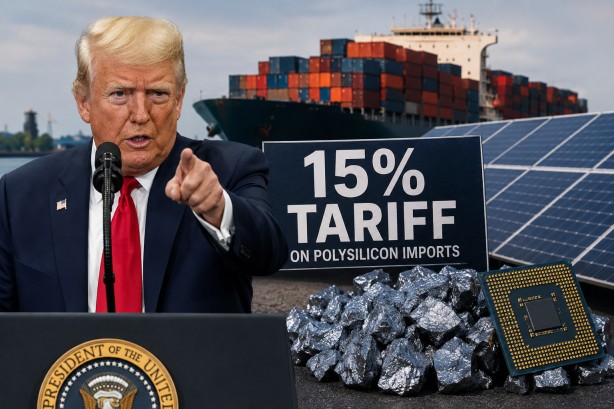
In a bid to bolster domestic manufacturing, US President Donald Trump has announced a 15% tariff on imported goods made with polysilicon, a crucial component in both semiconductor production and solar panel manufacturing. The tariff, which is set to be implemented on December 4, is part of a broader strategy to reduce the United States’ dependency on China for critical materials.
Polysilicon, a highly purified form of silicon, plays a significant role in the production of semiconductors that drive artificial intelligence technologies and data centers, as well as in the creation of solar cells and panels. With China being the global leader in polysilicon production, the new US tariffs aim to protect and enhance the viability of domestic production facilities.
Among the measures introduced are minimum import prices, which include $21 per kilogram for polysilicon, $100 per kilogram for polysilicon ingots and wafers, $0.22 per watt for solar cells, and $0.38 per watt for solar modules and panels. These steps are intended to support US polysilicon producers such as Hemlock Semiconductor in Michigan and Wacker Chemie in Tennessee.
The US administration emphasizes that these tariffs are crucial for ensuring the economic sustainability of domestic polysilicon production and for reinforcing supply chains vital to national security. In addition to tariffs, the government is also poised to offer incentives to companies that invest in domestic polysilicon and related manufacturing facilities.
China has expressed disapproval of the US decision, accusing the country of misusing national security as a pretext for restricting Chinese businesses. Beijing warns that such protectionist measures could potentially threaten the trade relationship between the two nations. Meanwhile, China continues to enjoy robust growth in its export sectors, particularly in electronics and artificial intelligence-related products.